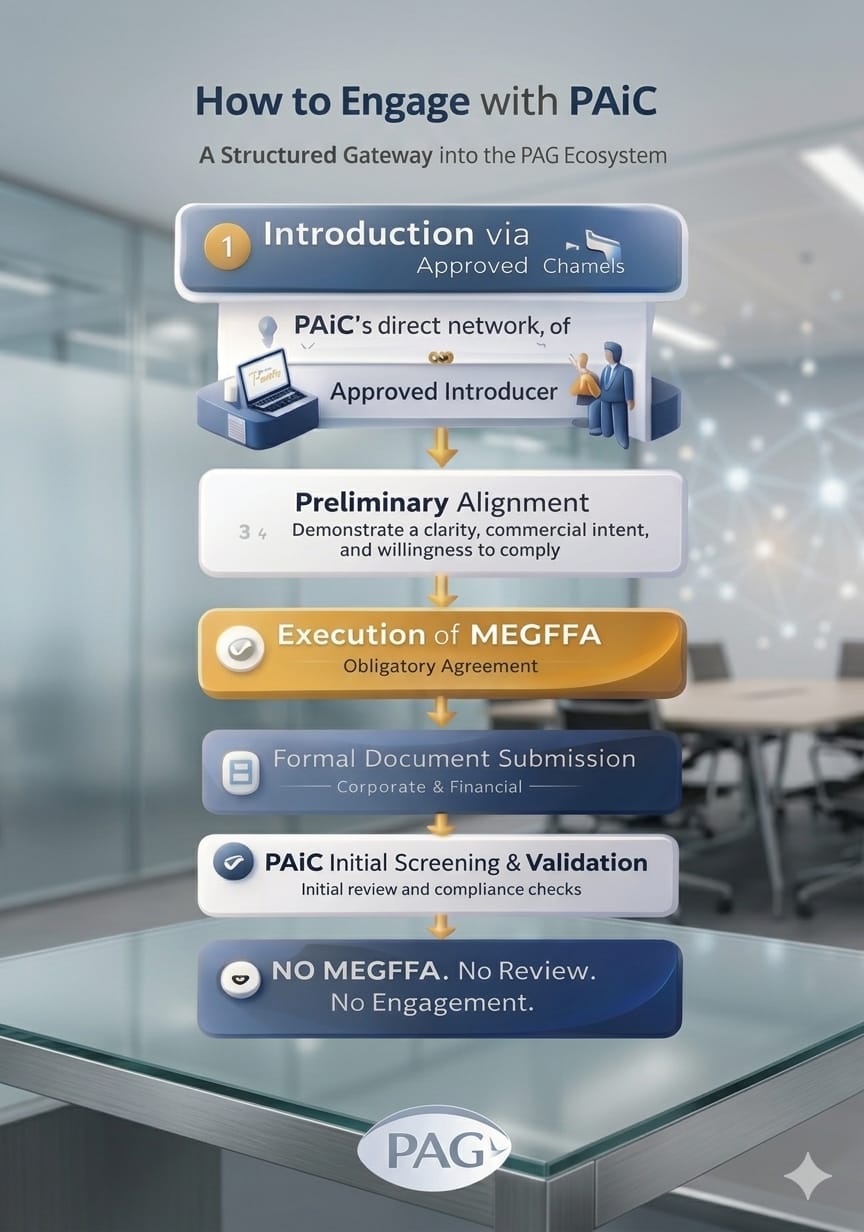
How to Engage with PAiC
A Structured Gateway into the PAG Ecosystem
Engagement with Pacific Alliance International Consulting (PAiC) is governed by a structured and disciplined framework designed to ensure that all opportunities entering the Pacific Alliance Group (PAG) ecosystem meet the highest standards of credibility, transparency, and governance readiness.
PAiC does not operate on informal discussions, unsolicited submissions, or undocumented engagements. All interactions are conducted through a formalised onboarding process that reflects institutional discipline and accountability.
This structured pathway is designed not only to protect PAG and its associated entities, but also to ensure that all prospective clients engage within a clear, fair, and professionally governed environment.
Step 1 — Introduction via Approved Channels
All prospective clients must be introduced through:
PAiC’s direct network, or
An approved introducer operating within the PAG ecosystem
Introducers play a critical role in ensuring that prospective clients are appropriately informed of PAG’s governance philosophy, engagement structure, and expectations prior to formal onboarding.
Unsolicited or unverified approaches will not be considered.
Step 2 — Preliminary Alignment
Prior to any formal engagement, the prospective client must demonstrate:
Clarity of the proposed transaction or project
Genuine commercial intent
Willingness to comply with PAG’s governance and compliance framework
At this stage:
No formal advisory is provided
No documentation is reviewed
No commitments are made
This step ensures that only serious and aligned opportunities proceed further.
Step 3 — Execution of MEGFFA (Mandatory Requirement)
The Mutual Engagement & Governance Framework Fee Agreement (MEGFFA) represents the mandatory gateway into the PAG ecosystem.
Execution of the MEGFFA confirms:
Understanding and acceptance of PAG’s governance framework
Acknowledgment of PAiC’s role as an client intake & preliminary screening, and coordination authority (not a broker or funder)
Agreement to due diligence, compliance, and non-circumvention principles
Commitment to transparency and professional conduct
No documentation will be accepted, reviewed, or processed without a duly executed MEGFFA.
Step 4 — Formal Document Submission
Upon execution of the MEGFFA, the prospective client will be invited to submit a complete set of documentation directly to PAiC.
This typically includes:
Corporate and organisational documentation
Financial statements and proof of financial standing
Transaction overview and supporting materials
Relevant contracts, agreements, or project documentation
All submissions must be complete, accurate, and verifiable.
Step 5 — PAiC Initial Screening and Validation
PAiC conducts a structured preliminary review which includes:
Documentation completeness verification
Logical and commercial consistency assessment
Initial compliance screening / FIGF
Preliminary credibility evaluation
This stage ensures that only viable and properly prepared opportunities proceed further into the governance process.
Step 6 — Submission to ZMA (ZMA-DD-001 Framework)
All cases that pass PAiC’s internal screening are submitted to:
Governance and Compliance Authority within the PAG ecosystem
ZMA conducts a comprehensive due diligence process under the ZMA-DD-001 framework, which includes:
Independent verification and authentication of documentation
Financial and legal due diligence
Risk identification and mitigation analysis
Governance suitability assessment
This stage represents the core institutional safeguard within the PAG structure.
Step 7 — Outcome Determination and Next Steps
Following completion of due diligence, the outcome will be determined as one of the following:
Approved
Conditionally Approved (subject to additional requirements)
Rejected
Only approved opportunities will proceed to:
SCPE™ structuring
Investor alignment and engagement
Transaction execution under PAG governance
Core Principle
No MEGFFA. No Review. No Engagement.
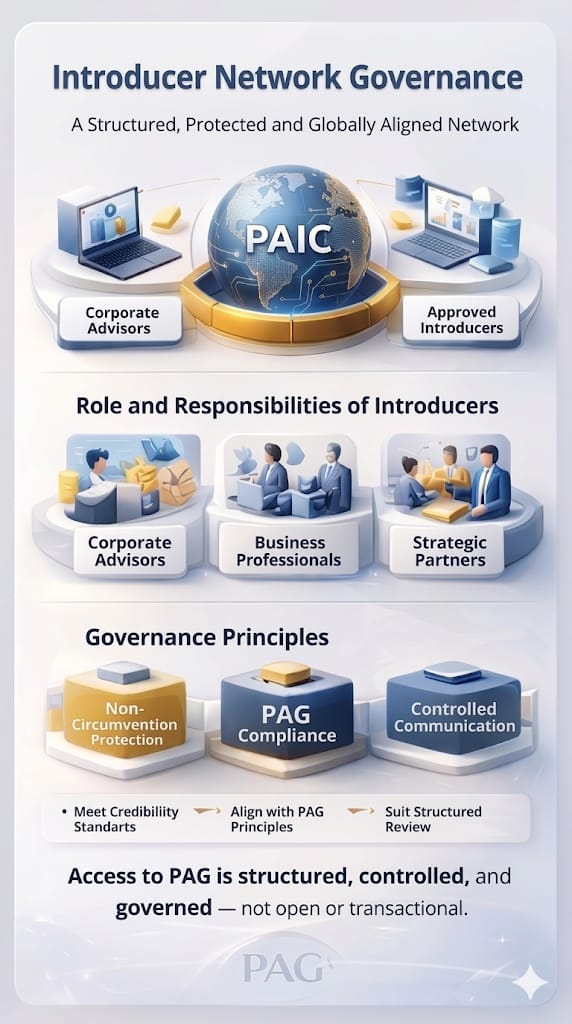
Introducer Network Governance
A Structured, Protected and Globally Aligned Network
Pacific Alliance International Consulting (PAiC) operates through a carefully curated global network of approved introducers, forming a fundamental pillar of the Pacific Alliance Group (PAG) ecosystem.
This network enables PAG to access diverse opportunities across multiple jurisdictions while maintaining strict governance, accountability, and operational discipline.
Nature of the Introducer Network
The PAiC introducer network comprises both professional and non-professional participants, including:
Corporate advisors and consultants
Business professionals and intermediaries
Strategic partners and affiliates
Independent connectors and relationship networks
This inclusive yet controlled structure allows PAG to operate globally while maintaining high standards of entry governance.
Role and Responsibilities of Introducers
Introducers serve as:
The initial point of contact with prospective clients
The first level of screening and alignment
The communication bridge between clients and PAiC
Their responsibilities include:
Introducing credible and legitimate opportunities
Ensuring that prospective clients understand PAG’s governance framework
Facilitating structured communication prior to formal onboarding
Introducers are expected to act with professionalism, integrity, and discipline at all times.
Governance and Operating Principles
All introducers operate under clearly defined governance principles, including:
Non-circumvention and protection of originating parties
Adherence to PAG engagement protocols
Compliance with communication and documentation standards
Introducers do not:
Represent PAG as employees or agents
Provide financial, legal, or investment advice
Guarantee funding or transaction outcomes
All authority remains strictly within PAiC and ZMA under the PAG governance framework.
Protection and Recognition Framework
PAG recognises the value of its introducer network and provides structured protection mechanisms, including:
Recognition of originating parties within the transaction structure
Protection of commercial interests subject to compliance
Structured engagement under formal agreements
All recognition and protection remain subject to governance validation and, where applicable, ZMA review.
Controlled Access and Quality Assurance
Not all introductions are accepted.
Each opportunity must:
Meet minimum credibility and documentation standards
Demonstrate alignment with PAG principles
Be suitable for structured governance review
This ensures that PAG maintains quality, integrity, and institutional credibility across all engagements.
Discipline at the Point of Entry
Introducers are expected to:
Avoid speculative, incomplete, or unverifiable submissions
Ensure clarity before initiating engagement
Maintain strict confidentiality and professionalism
Failure to adhere to these standards may result in disengagement from the network.
Core Principle
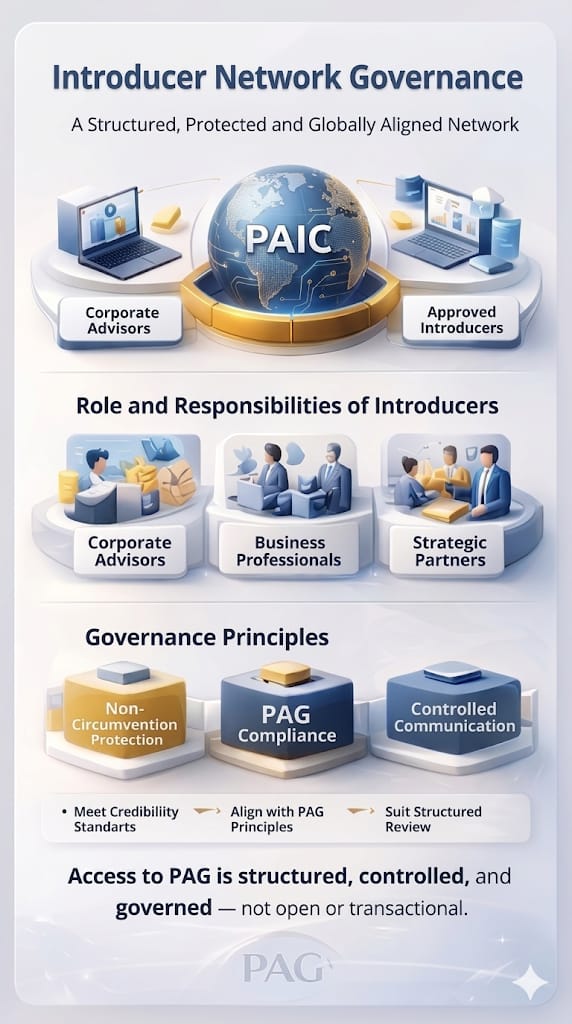
Access to PAG is structured, controlled, and governed — not open or transactional.
The PAG Governance Engagement Workflow
A Structured and Controlled Transaction Lifecycle
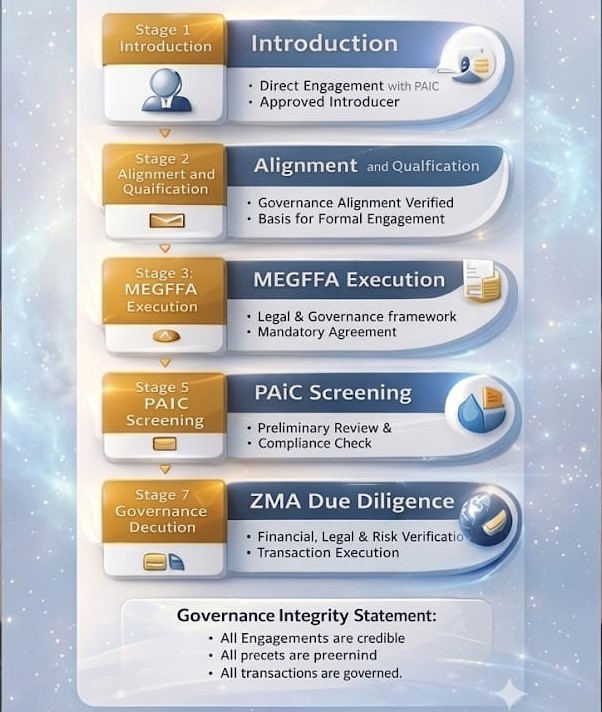
The Pacific Alliance Group (PAG) operates under a clearly defined governance workflow designed to ensure that every engagement is processed with discipline, transparency, and institutional oversight.
This workflow reflects the integrated roles of PAiC and ZMA within the PAG ecosystem.
Stage 1 — Introduction
The process begins with:
Direct engagement with PAiC, or
Introduction through an approved introducer
Only recognised channels are accepted.
Stage 2 — Alignment and Qualification
Stage 3 — MEGFFA Execution
Initial alignment ensures:
The opportunity is credible
The client understands PAG’s governance requirements
There is a basis for formal engagement
The MEGFFA establishes:
Legal and governance framework
Engagement structure
Rights and obligations of all parties
This is the mandatory gateway into the PAG system.
Stage 4 — Document Submission
Clients submit full documentation to PAiC for structured intake and review.
Stage 5 — PAiC Screening
PAiC conducts:
Preliminary review
Documentation validation
Initial compliance checks
Stage 6 — ZMA Due Diligence
ZMA performs:
Independent verification and authentication
Full governance and compliance assessment
Risk evaluation and structuring recommendations
Stage 7 — Governance Decision
Stage 8 — Structuring and Execution
Based on due diligence:
Approval
Conditional approval
Rejection
Approved cases proceed into:
SCPE™ program structuring
Capital alignment
Transaction execution under PAG governance
Every stage of this workflow is designed to ensure that:
All engagements are credible
All parties are protected
All transactions are governed
Contact
Email:
admin@pacificalliancegroup.my
Company Registration No.: 1349628-K
© 2024. All rights reserved.
Pacific Alliance International Consulting Sdn Bhd (PAiC)


Number:
+60192262789